So, the impending move is hanging over my head like some kinda dark storm cloud of doom. Sometimes it makes it a little difficult to breathe. I still have so much to do, and I am terribly overwhelmed by the amount of stuff I have. Who needs this much stuff?
Right now my world is full of lasts. Last lunch or dinner with so and so. Last trip to the Met. Last Broadway show. Last happy hour. As if I'm dropping off the face of the earth instead of down the coast three and a half hours. I can't complain; I encourage it. I love a sense of occasion. Though I find it amazing how many tried and true traditions I've developed in a little over a year and a half.
Really, my problem is paper. I hoard papers- maybe it's the writer thing. But I have boxes of papers I might want to scrapbook one day, boxes of old notes and readings from every scholarly institution I've ever attended that I refuse to throw away, boxes of notebooks full of scribblings- I think I have story outlines dating back to middle school and perhaps beyond. I'm pretty sure, at this point, that I'm not going to write those stories anymore. Isn't it time to throw this stuff away?
I mean, if I ever do make it big, future researchers will love to get their hands on my Juvenilia. "Look at this poem Yates wrote when she was seven!" (Yes, I have some of those, too). Though, with the kind of novels I want to write, I doubt anyone's going to be interested in the great vault of old writings I'll have amassed by the time of my death.
So I'll just haul my papers from town to townn and one day someone can have a big old bonfire.
Back to packing.
Wednesday, March 19, 2008


Thursday, March 13, 2008
Literary Tourism
I have just returned from my two day research excursion at the Beinecke Library at Yale. It was extraordinary. Almost enough to make me want to get up this life plan of possible mediocrity and popular fiction to sink back into the grottoes of Academia. Almost.
Well, maybe not.
I had to continually remind myself to stop being a tourist and become a researcher: a cold, calculating research machine, looking for answers to questions I wasn't quite sure I was asking. I couldn't. Instead, I asked for boxes containing materials I didn't need so I could check out notes for a novel that was never written or ogle Charles Dickens' signature. I took sneaky cell phone pictures of the more interesting artifacts ("Began Middlemarch"). I spent time caressing diary pages (with my eyes, of course, not my hands) in a loving way, not caring so much for what was written but how it was written. The written word has always instilled a sense of wonder in me, a wonder that graduate school has done its best to beat out; but as I sat in the reading room, diving through boxes and boxes of literary treasures, I felt that wonder sneak up and then rush over me.
This is the first time I have tried so thoroughly to get inside an author's head- reading her thoughts, touching her things- and it can't be done. You can't be in someone else's head, no matter how much you like or even understand their writing.
I am not sure how beneficial this visit was to my actual research. I think it has prompted more questions than it answered and I could certainly have gleaned much of the same information from just reading published copies of Marian Evans' diaries instead of making my head ache over her tiny, cramped scrawls. But it gave me a feel for her life and her attitudes about so many things. And it has actually made me start thinking of her as Marian Evans, to the point where I kind of feel awkward referring to her as George Eliot in my work.
Why do we still call her George Eliot? It wasn't her name, after all. And she isn't the first woman to publish under a man's pseudonym and later be revealed. Charlotte Bronte originally wrote as Currier Bell, but we now call her Charlotte Bronte. It's strange that we don't do the same for Evans/Eliot, and I wonder if it has something to do with her scandalous life and the many names she lived under (Mary Ann Evans, Marian Evans, Marian Lewes, Polly, Marian Cross). Maybe it's easier to just stick with the identity she used for her books and leave it at that. But I want to call her Marian Evans.
Thursday, March 06, 2008
Lesson du jour 2
I am not nearly hardcore enough about the opera to justify standing for four hours straight. Even if I did get to see the best seventeen minute mad scene ever.
Twelve hours later, my feet still ache.
Twelve hours later, my feet still ache.
Monday, March 03, 2008
Carla Bruni just got that much more awesome...

So, a few weeks ago, I discovered Carla Bruni. I like her because her songs are mellow and dreamy, and her latest album, No Promises, sets the poems of WB Yeats, Emily Dickinson, Dorothy Parker, Christina Rosetti (and more!) to music.
Today I read she is also the first lady of france. Awesome.
Though I am pretty sure I would never want to actually meet this woman. I have a feeling she would give me low self-esteem and possibly steal my husband/boyfriend/significant whatever.
I spent my weekend sitting and staring
This weekend, my sisters and mother came to visit me in the big apple one last time (get used to the constant refrain of "one last time" in my blogs and conversation for the next three weeks).
Because of this and some other factors, since Thursday, I have gone into dark theaters four times and sat for long stretches while people attempted to entertain me. Thursday night was Sunday in the Park with George. I took in Next to Normal at Second Stage Theater, off-broadway, for a Saturday matinee and Curtains on Broadway (though located further from the actual street than Second Stage Theater was) Saturday night. Sunday, after my family left, my roommate and I went to see The Other Boleyn Girl at the local cinema. And now it is time for Lightning Reviews!
Sunday in the Park with George
 This is the first Stephen Soundheim production I've seen that I've diskliked. Strongly. Sadly, out of my weekend list, it's also the one with the biggest ticket price. Boy Roommate 2 bought Boy Roommate 1 tickets for Valentine's Day, and the rest of us tagged along. Rear Mezzaine. $57.
The music is often unapproachable, even for Soundheim, but what is worse is the lack of coherent plot and relatable characters. The first act follows painter George Seurat and the second revolves around his grandson, also a somewhat inhuman artist. I didn't care about either George, but at least the first one is surrounded by interesting characters. The second act made me want to pull my hair out. I have never been so bored in a Broadway theater in my entire life. The real star of the show is the scenery, which, through a variety of projections creates the actual park, the painting of the park, a light show, and various living creatures: a soldier, two dogs, and various moving, talking copies of the grandson George. The scenery is never boring.
Next to Normal
 This is my favorite of the bunch. I knew very little of the plot and nothing of the music going into it. The songs are compelling ("I like my angst with a heavy beat" I explained to my roommates, afterwards), very high energy, though the lyrics occasionally rely on somewhat infantile, Rent-esque rhymes. It also, at times, seems a little long (though every show on this list seemed long, so that might just be me). Still, I feel these things could be easily fixed if the play tries for a Broadway run, which is apparently being considered. I love the cast, especially this kid, the new Broadway love of my life (I mean, John Gallagher Jr.'s disappeared, so a girl needs someone to turn to for comfort). The plot is character driven and full of layers, letting the audience discover secrets and sources of pain in a slow and sometimes shocking fashion. It's a play that grows on you, if me and my sisters are any indication: leaving the theatre, we liked it, but as the day wore on, we loved it and positively lusted to hear the music again.
Curtains
 Curtains is light and amusing and if that is all you look for in a Broadway show, it will fill your dance card perfectly. Curtains actually utilizes many elements of Old Broadway: catchy songs- a blend of happy numbers and ballads, rousing dance numbers, star power (David Hyde Pierce, Debra Monk, Karen Ziemba), a show within a show, and elaborate sets. It is entertaining and you can mentally check in and out of the show and still follow things. That's really it.
The Other Boleyn Girl
Or "How I Spent My Summer Vacation, by Anne Boleyn."
First off, the movie squeezes about six hundred pages of novel and a dozen years of history into what feels like a couple of months. Girl Roommate assures me that the only reason I did not vehemently hate this film is because I am so fascinated by Jim Sturgess (and how Hollywood convinced me that this man is devastatingly attractive is an issue to be dissected later). The film murders both history and the Phillipa Gregory novel on which it is based. Eric Bana is completely wasted on the role of King Henry, who has no point in the film besides smoldering and lusting after the Boleyn sisters; there are no politics or intrigues beyond these seductions. Natalie Portman is a passable Anne, though in the film she is shrill and desperate where in the book she is confident and conniving. Poor Jim Sturgess does the best he can with George Boleyn, terribly watered down from the book as well. One of the most fascinating aspects about the novel is that Anne and George are so in love/lust with being Boleyns that they naturally turn this into love/lust for each other. They are this pair of smart, sexual predators dominating and destroying Mary's world. In the film, there's not much to destroy: Mary is basically a peripheral figure in her own story. I'm not sure who the star becomes instead: perhaps Natalie Portman, perhaps general darkness (there was not enough light used in the filming of this movie- why must so many period pieces be so dark?), or perhaos just the insides of your eyelids (I did almost fall asleep a few times).
Because of this and some other factors, since Thursday, I have gone into dark theaters four times and sat for long stretches while people attempted to entertain me. Thursday night was Sunday in the Park with George. I took in Next to Normal at Second Stage Theater, off-broadway, for a Saturday matinee and Curtains on Broadway (though located further from the actual street than Second Stage Theater was) Saturday night. Sunday, after my family left, my roommate and I went to see The Other Boleyn Girl at the local cinema. And now it is time for Lightning Reviews!
Sunday in the Park with George
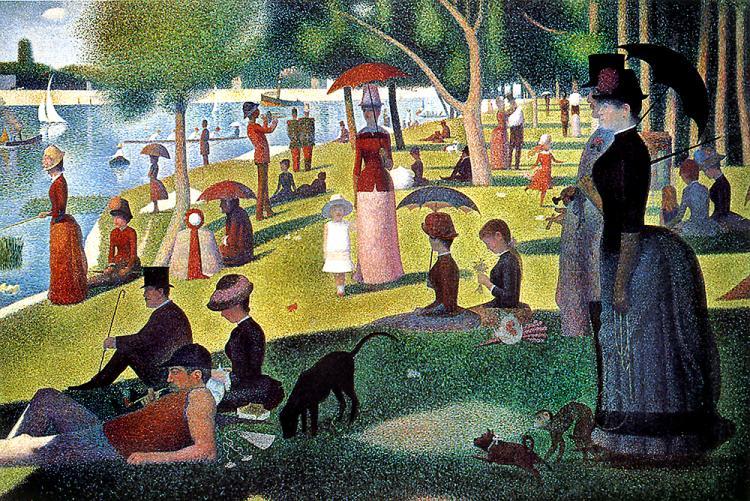 This is the first Stephen Soundheim production I've seen that I've diskliked. Strongly. Sadly, out of my weekend list, it's also the one with the biggest ticket price. Boy Roommate 2 bought Boy Roommate 1 tickets for Valentine's Day, and the rest of us tagged along. Rear Mezzaine. $57.
The music is often unapproachable, even for Soundheim, but what is worse is the lack of coherent plot and relatable characters. The first act follows painter George Seurat and the second revolves around his grandson, also a somewhat inhuman artist. I didn't care about either George, but at least the first one is surrounded by interesting characters. The second act made me want to pull my hair out. I have never been so bored in a Broadway theater in my entire life. The real star of the show is the scenery, which, through a variety of projections creates the actual park, the painting of the park, a light show, and various living creatures: a soldier, two dogs, and various moving, talking copies of the grandson George. The scenery is never boring.
Next to Normal
 This is my favorite of the bunch. I knew very little of the plot and nothing of the music going into it. The songs are compelling ("I like my angst with a heavy beat" I explained to my roommates, afterwards), very high energy, though the lyrics occasionally rely on somewhat infantile, Rent-esque rhymes. It also, at times, seems a little long (though every show on this list seemed long, so that might just be me). Still, I feel these things could be easily fixed if the play tries for a Broadway run, which is apparently being considered. I love the cast, especially this kid, the new Broadway love of my life (I mean, John Gallagher Jr.'s disappeared, so a girl needs someone to turn to for comfort). The plot is character driven and full of layers, letting the audience discover secrets and sources of pain in a slow and sometimes shocking fashion. It's a play that grows on you, if me and my sisters are any indication: leaving the theatre, we liked it, but as the day wore on, we loved it and positively lusted to hear the music again.
Curtains
 Curtains is light and amusing and if that is all you look for in a Broadway show, it will fill your dance card perfectly. Curtains actually utilizes many elements of Old Broadway: catchy songs- a blend of happy numbers and ballads, rousing dance numbers, star power (David Hyde Pierce, Debra Monk, Karen Ziemba), a show within a show, and elaborate sets. It is entertaining and you can mentally check in and out of the show and still follow things. That's really it.
The Other Boleyn Girl
Or "How I Spent My Summer Vacation, by Anne Boleyn."
First off, the movie squeezes about six hundred pages of novel and a dozen years of history into what feels like a couple of months. Girl Roommate assures me that the only reason I did not vehemently hate this film is because I am so fascinated by Jim Sturgess (and how Hollywood convinced me that this man is devastatingly attractive is an issue to be dissected later). The film murders both history and the Phillipa Gregory novel on which it is based. Eric Bana is completely wasted on the role of King Henry, who has no point in the film besides smoldering and lusting after the Boleyn sisters; there are no politics or intrigues beyond these seductions.
 Natalie Portman is a passable Anne, though in the film she is shrill and desperate where in the book she is confident and conniving. Poor Jim Sturgess does the best he can with George Boleyn, terribly watered down from the book as well. One of the most fascinating aspects about the novel is that Anne and George are so in love/lust with being Boleyns that they naturally turn this into love/lust for each other. They are this pair of smart, sexual predators dominating and destroying Mary's world. In the film, there's not much to destroy: Mary is basically a peripheral figure in her own story. I'm not sure who the star becomes instead: perhaps Natalie Portman, perhaps general darkness (there was not enough light used in the filming of this movie- why must so many period pieces be so dark?), or perhaos just the insides of your eyelids (I did almost fall asleep a few times).
Subscribe to:
Posts (Atom)


